By Michael Oche
As Nigeria prepares for the 2027 general elections, stakeholders in the country’s electoral process have issued a strong call for urgent electoral reforms to eliminate godfatherism, strengthen institutions, and restore public confidence in the electoral process.
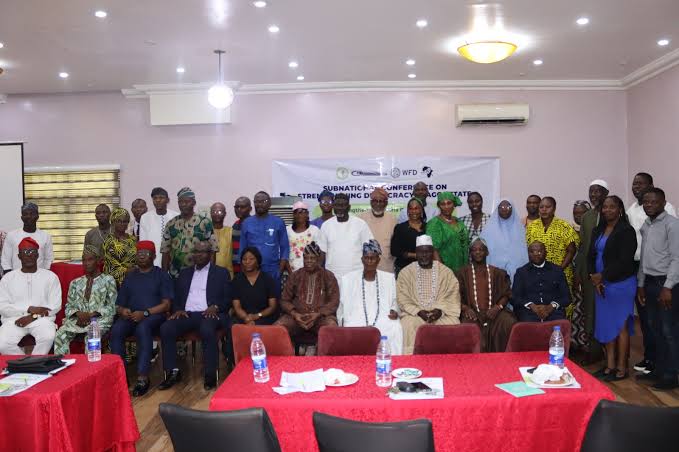
The call was made at the Subnational Strengthening Democracy Conference held in Lagos with the theme “Pathway to Good Governance and Political Integrity.”
Organized through a strategic partnership among the Peering Advocacy and Advancement Centre in Africa (PAACA), Centre for Leadership, Strategy & Development (Centre LSD), Centre for Democracy and Development (CDD), and the Westminster Foundation for Democracy (WFD), the conference examined the state of Nigeria’s democracy and identified actionable reforms.
The Conference brought together diverse stakeholders from academia, political parties, civil society organizations, traditional leaders, media professionals and governance experts to assess democratic progress and propose actionable reforms, at subnational level.
In his welcome address, Director of Strategy at the African Centre For Leadership, Strategy & Development (Centre LSD), Itia Otabor called for the strengthening of democratic institutions at the subnational level especially after the national conference due to the decay in democratic values in recent times.
Otabor expressed concern over weak institutions, poor internal party structures, and the lack of ideological consistency among political parties, arguing that without strong democratic institutions and well-structured parties, Nigeria’s democracy would remain unstable
The keynote speaker, Dr. Asekere Olujoke, a senior lecturer in the Department of Mass Communication, Yaba College of Technology, in her address, stressed that while credible and peaceful elections are essential for democracy, they are not enough.
“One key determinant of a flourishing democracy is the quality of institutions,” she stated.
“Institutions such as the Independent National Electoral Commission (INEC), the judiciary, the police, and other law enforcement agencies must be strengthened to ensure independence, efficiency, and accountability,” she added.
According to her, “These institutions should have financial adequacy and autonomy without strings attached. Attached to this, is the appointment of commissioners of INEC. Such appointment must be transparent and senatorial approval must be based on integrity and expertise. Operational autonomy and accountability mechanisms of these institutions are key to strengthening democracy.”
Dr. Olujoke also underscored the need for greater citizen participation in the democratic process, advocating for voter education, mobilization, and increased civic engagement to promote informed electoral choices.
In his paper presentation, Mr. Kunle Adegoke (SAN) emphasized the crucial role of stakeholders, civil society organizations (CSOs), the media, security agencies, political parties, and INEC, in strengthening Nigeria’s electoral process.
He highlighted the importance of an independent judiciary in upholding electoral laws and ensuring justice in election disputes.
“A compromised judiciary is an albatross to the dispensation of justice,” he warned. “It must be shielded from political interference to maintain public confidence in the system.”
On the role of security agencies, Adegoke stressed that their duty is to prevent electoral fraud, voter impersonation, ballot stuffing, and other forms of manipulation. However, he noted that security agencies have often failed in this regard and called for urgent reforms to ensure they uphold electoral integrity rather than serve political interests.
The guest speaker, Professor Sylvester Odion Akhaine, a pro-democracy advocate and governance expert, in his speech, described godfatherism as a major obstacle to credible elections, stressing that political parties must prioritize internal democracy.
He said, “When a few powerful individuals determine who gets elected, democracy becomes a façade rather than a system that reflects the will of the people,” he stated.
Meanwhile, a communique issued at the end of the conference outlined crucial reforms to enhance Nigeria’s electoral integrity and curb political manipulation