By Austin Okeke
It is not every day that you get the opportunity to mingle with the legends of our time. It is not ordinary to make history with those whose names you have read in your history books at school. These were people who have benefitted mankind in many ways through history. It must be something beyond chance that made this happen to me. It must have been grace, the unmerited favour that placed me amongst these great people.
It was indeed overwhelming for me to be seen on the front pages of newspapers in South Africa, standing amongst the likes of Archbishop Desmond Tutu, Helen Suzman, the leaders of the ANC, the leaders of the Jewish, Indian, Caucasian, political parties, trade unions, religious groups, African communities and other personalities I have read of in my primary and secondary school days back in Nigeria. This, for me, was mind-blowing. Well, it happened.
These are my lived realities, which I am still busy narrating and documenting in my memoirs titled “Grace, the unmerited favour” and subtitled “Expression of Eloquence, Faith and Spiritual Warmth”. It is a comprehensive account with pictorial and material evidence that would be available on Amazon in the near future. Watch out for it.
My pro-democracy activities and campaigns in South Africa were not a bed of roses. It took a lot of my time, talent, and treasure. No regrets whatsoever. On the contrary, I write with a sense of fulfilments, accomplishments, and gratitude to God for His Grace and the divine opportunity to demonstrate his presence in my life. It is a good feeling to serve as a channel and vessel of divine grace and as an instrument in God’s hand.
Many pressure groups and organisations invited me for speeches in their support events for the return of democracy in Nigeria. One such group is the Democratic Writers of South Africa. This is a platform for journalists and editors. We also had the guild of foreign journalists, the academia in the universities, and the Foundation for Global Dialogue, etc. I fondly remember my interview with the United Nations TV. In closing, I was asked what message I would like them to take to my people back in Nigeria. I said, “Go home and tell them, for their tomorrow I die for today.”
Growing up as a Catholic, I was moulded by the teachings and the spirit of Jesus Christ. At that spot during the interview, what readily came to mind was my next answer: “greater love has no man than he that laid down his life for his fellow man.” The interviewer was speechless. I was frequent on national and international TV stations, radio stations, periodicals, and newspapers talking and explaining to the world about the atrocities in Nigeria under the watch and command of the late General Abacha at the time. I was amplifying the dire situation and vehemently campaigned against the late Abacha regime.
Dr Nelson Mandela-led ANC government invested immeasurable resources in the campaign against the military regime of the late General Sani Abacha. After Dr Nelson Mandela, I was the next face of the struggle against the late General Sani Abacha regime. As a consequence of these activities, all the international organisations known to us placed stringent sanctions against the Abacha regime, which essentially rendered his administration useless and a pariah to the free world.
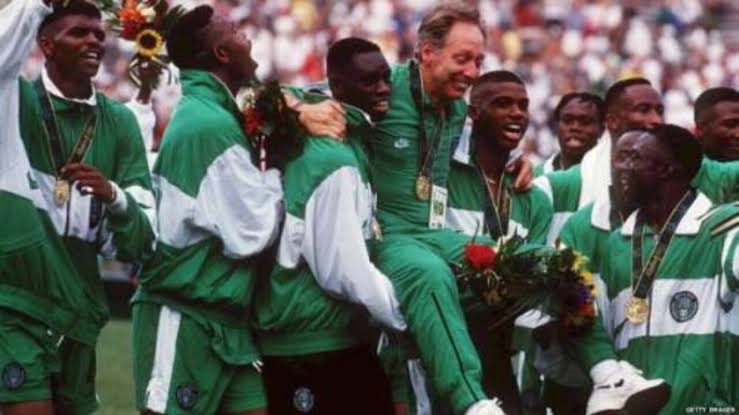
The Super Eagles, the national soccer team of Nigeria, won the African Cup of Nations in 1994. In 1996, South Africa hosted the soccer tournament. The Super Eagles, therefore, must participate in order to defend its title as the champions. Little did we know that the late General Sani Abacha was waiting to strike. He was so selfish as to have weaponised the continental soccer tournament. He saw it as an opportunity to retaliate the role of South Africa in bringing about multiple sanctions against his military regime in Nigeria.
The whole continent waited with bated breath for the likes of Jay Jay Okocha, Samson Siasia, Sunday Oliseh, Peter Rufai, Uche Okafor, Uche Okechukwu, Chidi Nwanu, Augustine Eguavon, Stephen Keshi, Daniel Amokachi, Finidi George, Emmanuel Amunike, Kanu Nwankwo, Victor Ikpeba, Rashid Yekini, and other outstanding players of USA 1994 and the golden boys of Atlanta Olympics 1996. The atmosphere in South Africa and, indeed, the African continent was electrifying, thrilling, palpable, and captivating, to say the least. The Super Eagles had more South Africans who are their fans than Bafana Bafana, their national soccer team. We were looking forward to the day both sides would play each other during the tournament.
Every day, the news about the arrival of other African teams was on the front pages of all the newspapers, and it made headlines on the TV news as well. Fan villages were buzzing with activities and fanfare on a daily basis. Some few days before the opening ceremony of the African Cup of Nations, I received a phone call from the Nigerian High Commission in Pretoria, South Africa. They wanted me to assist with the arrangements and logistics in anticipation of the arrival of the Super Eagles, the African champions. I was officially informed that the city of Durban was the venue for their group stage matches.
Based on this, I made arrangements with a nominated hotel in Durban, and I made special arrangements to use their kitchen to prepare their Nigerian foods throughout the tournament. I then mobilised some members of the Nigerian community for assistance, and we established a task team. I met with Aunty Bose so as to be in charge of the supply of Nigerian food stuff and the cooks, and I also met with Joana Amanfoh, who was at the time running a Nigerian restaurant at Mount Batten apartment in Johannesburg to join the food task team. Joana is now a lawyer in Canada. I met with the manager of Ghana Airways for daily supply of fresh farm produce from West Africa. Nigeria Airways had no plane coming to South Africa at the time.
Out of nowhere, I was contacted by Reebok South Africa. Reebok was, at the time, one of the sponsors of the Super Eagles. Therefore, Reebok South Africa wanted to sell their merchandise and sporting apparel to the supporters club and the fans in the Southern African region. I negotiated and closed the deal. In the process, I was informed that John Fashanu, the football legend, was the right holder for Reebok Africa, and that a certain Igbo guy in Kenya, whom I eventually contacted was in charge of East African businesses and sales.
The Nigerian community in South Africa and the countries in the Southern African region got together in preparation for the arrival of the Super Eagles. The Nigerian association in South Africa at the time actively coordinated the other Nigerian communities in the Southern African region. The leadership status of South Africa in this region is similar to the leadership status of Nigeria in the ECOWAS region. Those were the glory days, though.
The supporters club in Nigeria got hold of me for coordinated arrangements. The supporters club and Nigeria cultural group in South Africa with drummers and dancers in traditional attires had rehearsed in readiness for the arrival of the Super Eagles at the Johannesburg International Airport. It was all systems go. We also had our media and video crew on standby.
Suddenly, we woke up one ill-fated morning to the announcement that the late General Sani Abacha had with military fiat ordered the Super Eagles not to travel to South Africa just to spite Dr Nelson Mandela. It was the worst infantile decision ever made by any right thinking president. The absence of the Super Eagles did not in any way disadvantage South Africa or Dr Nelson Mandela. In fact, South Africa proceeded to win the tournament.