
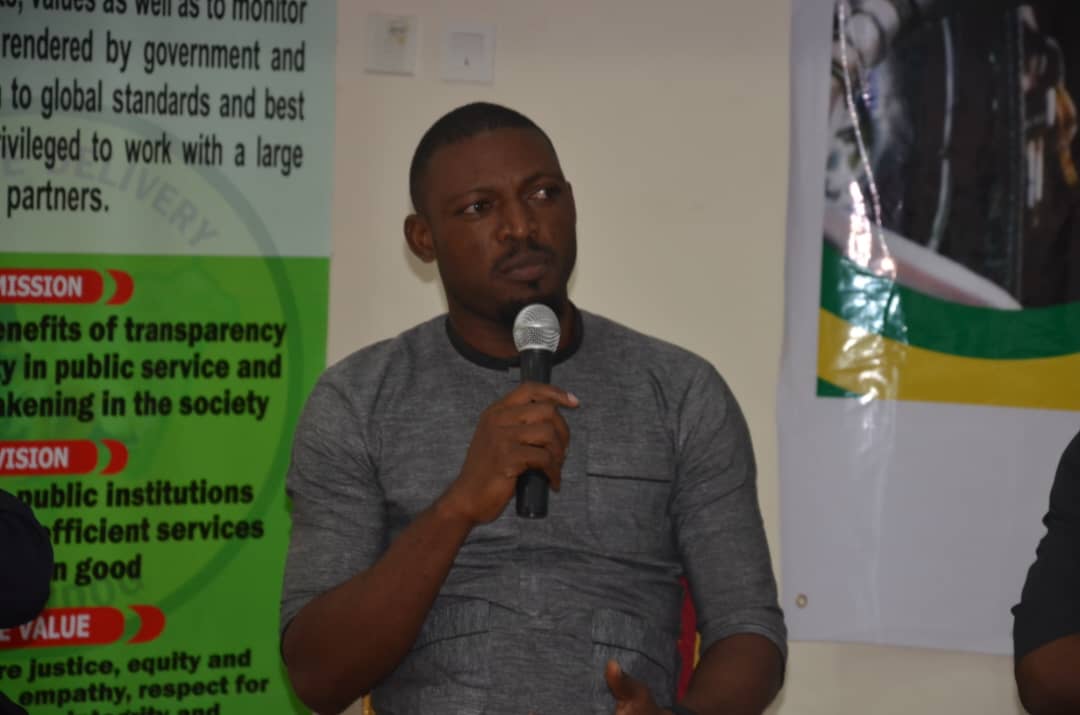
A man passionately discusses climate change issues during the Belem 2025 conference in Africa.
By Michael Oche
When African negotiators arrive in Belém, Brazil, for the 30th UN Climate Change Conference (COP30) in November, they will carry with them not just the weight of a continent battered by climate shocks, but also a fresh set of demands that could redefine Africa’s place in global climate change politics.
For the first time in history, Africa’s trade unions have formally engaged the African Group of Negotiators (AGN), presenting a 10-point agenda that insists on climate justice rooted in social justice.
The question, however, remains: will COP30 deliver for Africa or will it become yet another missed opportunity in a long line of global summits that promised much but achieved little?
Africa’s experience with past climate change summits is sobering. Despite contributing less than 4 percent, the least to global greenhouse gas emissions, the continent continues to face the harshest consequences – rising temperatures, droughts, floods, food insecurity and energy poverty.
Climate shocks are already costing Africa heavily. According to the African Development Bank, the continent loses between $7–15 billion annually to climate-related impacts, a figure projected to rise to $50 billion per year by 2040 if urgent action is not taken.
Yet, the promises of financing, technology transfer and fair energy transitions made at previous COPs have largely failed to materialize.
The $100 billion annual climate finance pledge, first made in 2009, remains unfulfilled. Worse still, a significant portion of the climate finance Africa receives comes in the form of loans rather than grants further deepening debt vulnerabilities.
Instead of relief, African countries are saddled with ballooning debts, compounded by illicit financial outflows estimated at $88 billion annually, and structural adjustment-style policies that continue to push them toward privatization and austerity policies that deepen energy poverty rather than resolve it.
For many observers, COP after COP have been a cycle of high-level declarations followed by weak delivery.
What makes COP 30 potentially different, however, is the entry of organized African labor into the negotiation process. In August, ITUC-Africa led trade union leaders, civil society organizations and other groups of climate change activists to meet with the AGN.
After the historic meeting in Dar es Salaam, African workers under the African Regional Organization of the International Trade Union Confederation (ITUC-Africa) handed a bold 10-point climate agenda to the negotiators.
At the heart of the workers’ demands is a call for Public Pathways Energy Transition, a rejection of privatization schemes like Mission 300, which workers argue entrench inequality and keep electricity out of reach for millions. Instead, they propose community-driven, publicly owned energy systems that guarantee affordable, reliable and sovereign access to power.
The workers’ agenda also tackles financing head-on, demanding the cancellation of Africa’s “odious debts” and an end to the $88 billion lost annually through illicit financial flows. They propose redirecting these resources into climate action and establishing a continent-wide Social Protection Fund to cushion workers and communities during the transition.
Equally striking is the call for embedding labor in climate governance. Workers want trade unions represented in the design and review of Nationally Determined Contributions (NDCs), social dialogue institutionalized, and a Global Just Transition Mechanism secured at COP30.
The new collaboration between African workers and the AGN is more than symbolic. For decades, one critique of Africa’s participation at COPs has been the fragmented, often reactive posture of its negotiators. Workers insist that “Africa must speak with one voice,” a call echoed by ITUC-Africa’s President, Comrade Martha Tinny Molema, who declared that climate action must “create decent work, protect livelihoods and leave no worker or community behind.”
This partnership brings lived realities of workers, women, youth and informal communities directly into the negotiating space. By embedding these perspectives, the AGN can strengthen its legitimacy and present a united, people-centered African position at Belém.
Africa stands at a crossroads. On one path lies the continuation of broken promises, half-measures, and externally imposed models of transition that deepen dependency. On the other lies a sovereign, socially just and inclusive climate agenda driven by African priorities.
As ITUC-Africa’s General Secretary Akhator Joel Odigie puts it, “There can be no climate justice without social justice.” For Africa, the success of COP30 will not be measured in speeches or pledges, but in whether concrete mechanisms are secured to finance just transitions, protect workers, and ensure that the continent’s mineral wealth and renewable potential benefits its people rather than foreign interests.
For ordinary citizens, the urgency of these demands lies in the daily realities of climate change: rising food prices as farms fail from prolonged droughts, homes washed away by floods and entire communities forced to migrate because the land can no longer sustain them. When African negotiators and workers insist on more climate finance, debt relief and social protection, it is because without these, governments cannot shield citizens from hardship or build resilience against worsening disasters. In simple terms, the fight for fair climate action is about ensuring that African families can still eat, work and live safely in the face of a warming world.
The choices made in Belém will shape Africa’s future for decades to come. COP30 could be the turning point but only if Africa’s negotiators, backed by the voices of workers and communities, remain bold, principled and uncompromising.
Michael Oche is journalist based in Abuja


