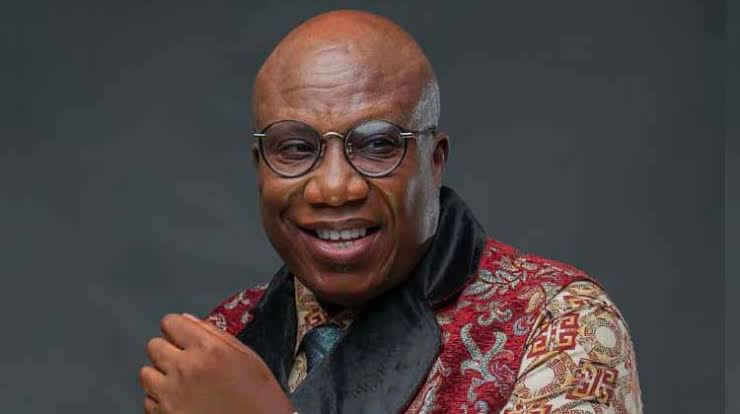
By Edentu oroso
The Nigerian music industry, a dazzling galaxy of stars, would be glaringly incomplete without the luminous presence of one man: Mike Okri. A doyen of highlife and Nigerian pop music in the late 1980s and early 1990s, his crooning on vinyl delivered timeless hits like Omoge, and Time Na Money, cementing his legacy as more than just a fleeting phenomenon. With a soulful, captivating voice, Mike Okri weaves motivational narratives into exquisite lyrics, set to mesmerizing mid-tempo rhythms. His artistry transcends entertainment, securing his place among Nigeria’s timeless legends.
Born on August 6 in Ughelli, Delta State, Mike’s sweetplod in the realm of music began at six, when rhythm and melody became an inseparable part of his earliest memories. Even as a child, his innate poise and charm marked him as a prodigy, a natural luminary at every gathering. “At birthday parties, I’d steal the show,” he fondly recalls. “I’d outdance everyone and win the coveted prizes—jollof rice, a larger piece of chicken. Those were treasures to a child like me.”
Growing up on AjokeDosunmu Street in Surulere, Lagos, a vibrant cultural hub, Mike’s talent flourished. At Saint Mary’s Nursery and Primary School, his gift took root when he was drafted into the choir to sing Christmas carols, discovering the joy of performance. “My voice was delicate and piercing, like a young lady’s, capable of moving souls,” he reflects.
Music was more than a calling for Mike—it was a legacy. His mother, a revered traditional singer, led her community in songs that echoed their heritage, leaving an indelible mark on her son. While her artistry never graced the national stage, it inspired Mike to carry her gift forward with profound passion. “At six, I felt destined to be a singer, though I couldn’t yet fathom if it would shape my life’s work,” he confides. Though many of his siblings inherited her talent, Mike’s talent transcended, elevating their family’s musical tradition to extraordinary heights—a tribute to the quiet legacy she had sown.
Mike’s artistic inclinations extended beyond music. “I believed I was going to be a playwright,” he shared. “Even as a child, I was already writing letters. Our family is steeped in literature. My elder brother, Ben Okri, is a celebrated writer, and my other siblings, in their own ways, are writers too.
The Okri family embodies a legacy of creativity and literary brilliance, a tradition that continues to inspire. Mike Okri rose to prominence in the late 1980s and early 1990s, captivating audiences with pulsating rhythms and masterful hits like Omoge and Wisdom, cementing his place in Nigerian music history. But his journey began humbly in 1982, singing as a session musician in studios and performing with various bands. “I was everywhere,” he recalls. “Even in school, I’d sneak out to join any jamboree—from Ife to Port Harcourt, Bendel State, Ibadan, and Lagos.”
At the time, Abuja hadn’t yet emerged as an entertainment hub, but vibrant scenes thrived in Benue and the Middle Belt, offering fertile ground for musical expression. “Music was magical then,” Mike reminisces. “We performed on campuses, with bands, anywhere we could make a mark. Eventually, I settled in and began travelling abroad—that’s how far my voice carried me.”
Mike honed his craft alongside some of Nigeria’s greatest music maestros. He had memorable stints with King Sunny Ade, a brief collaboration with the Ozidi king, Sonny Okosuns, and performances with the Zigida crooner UcheIbeto, as well as numerous smaller bands. Yet, it was his time with the late elegant stallion OnyekaOnwenu that truly sharpened his musical instincts. For three solid years, he sang backup for her before finally embarking on his solo career.
You could hear it in Mike’s music—an unmistakable distinction, a unique essence that elevated him a notch higher than the motley bunch. Those in his circle, particularly the musically inclined, recognised his gift early on. “I always knew I was a special crooner, a vocalist in a league of my own,” Mike reflected. “That confidence helped me carve out a path. Every time I sang somewhere, people would approach me, saying, ‘Hey, I need your voice on my music or in the studio.’ That demand turned me into a sort of musical potpourri, blending into everyone’s projects. I was captivating souls, and it thrilled me to see what I had become and what I was destined to be.”
Mike Okri’s dazzling artistry was unveiled by legendary music producer Laolu Akins. “I had done several demos before,” Mike recalls, “but the one that changed everything was with Fortune Otega, my musical partner. We were session men with OnyekaOnwenu and the Kabasa Band when Fortune told me, ‘It’s time for you to step out.’ That demo eventually reached Laolu Akins, and it set my career in motion.”
At the time, CBS Nigeria, owned by the Okunowas, was scouting local talent, and Mike became their first indigenous signee. “It was destiny unfolding,” he reflects. In 1988, he released Concert Fever, his debut album, and his journey as a musical icon began—a legacy punctuated by rhythms that still resonate across generations.
Mike Okri reflects on the coexistence of his era’s music with that of the new generation as a thing of beauty, emphasizing the need for continuity between the two. He contrasts Nigeria’s mono-dimensional approach with the West, where deliberate efforts ensure younger generations connect with timeless artistry. “Over there, they intentionally pass down wisdom, and the results speak for themselves,” he notes.
Okri admires today’s artists for leveraging social media to achieve global reach instantly—something unimaginable in his time, when album syndication could take years. Yet, he sees himself as a bridge between generations, committed to uniting the past and future of Nigerian music through mentorship and legacy-building.
For Mike Okri, music was a serious craft, shaped by masters who understood its essence—a stark contrast to today’s artists, many of whom lean on technology to mask imperfections rather than mastering their art. While some rise above their flaws, others produce fleeting hits that lack longevity. Bridging this generational gap, he believes, requires reviving the discipline and artistry that once defined Nigerian music. Humbled by the unwavering support of fans who find meaning in his songs, Okri reflects, “It’s this connection that keeps me going. I thank God for the journey so far and look forward to contributing even more to the legacy of timeless music.”
Mike Okri’s illustrious music career was defined by three iconic albums. His debut, Concert Fever, marked his entry into the industry, while his sophomore album, Rumba Dance, produced in collaboration with Sony Music and Benson and Hedges, propelled him onto the global stage with a successful world tour. “It was a tremendous success,” he recalls proudly.
His third album, Cracks, released under Premier Music, featured the hit track Wisdom with its memorable refrain, “Hear your mama, hear your papa.” These three albums cemented his stardom. “While I’ve worked on other projects, none compare to the impact of these three masterpieces,” he reflects.
At the peak of his career, Mike Okri left Nigeria in what he calls a “self-exile” guided by faith, not strategy. “Sometimes, you don’t know where the wind will take you, but you hold on to faith, trusting God won’t let you fall. I held on, I survived, and today, I can say I’ve done well,” he reflects.
“Stay strong, trust God, do your best, and leave the rest to Him” is the cornerstone of Mike Okri’s philosophy. He also champions the belief, “Be a believer in yourself, so you don’t become someone caught between worlds. The most distracting thing is listening to others so much that you lose what is authentically you. When you believe in yourself positively, you inspire others to believe in you—and that’s my guiding principle.”
What fuels Mike Okri is an unwavering confidence in his craft, tempered by an openness to listen and learn. He acknowledges the paradox of self-reliance: “I may be like an island surrounded by the vast ocean, capable of surviving, but I also recognize the need to lean on others for fresh ideas and perspectives.”
For Mike Okri, talent thrives in collaboration, creating a vibrant spectrum of harmonies. “I find joy in recognizing other talents; together, we create something extraordinary,” he says. He urges the younger generation to embrace self-discovery over fleeting trends, emphasizing introspection. “When you truly know yourself, you’ll find your niche. The journey may start uncertain, but with determination and clarity, resilience grows, making every step worthwhile.”
Mike Okri’smusical stead is an intricate web of rich impressions, intricately woven into the halls of music’s grand pantheon. Defined by acclaimed artistry and unwavering commitment to his principles, he stands as a luminous gift to the music world, his contributions resonating in collective memory. With unmatched charisma and enduring legacies, Mike Okri remains an icon whose influence transcends time.