By Palma Ileye
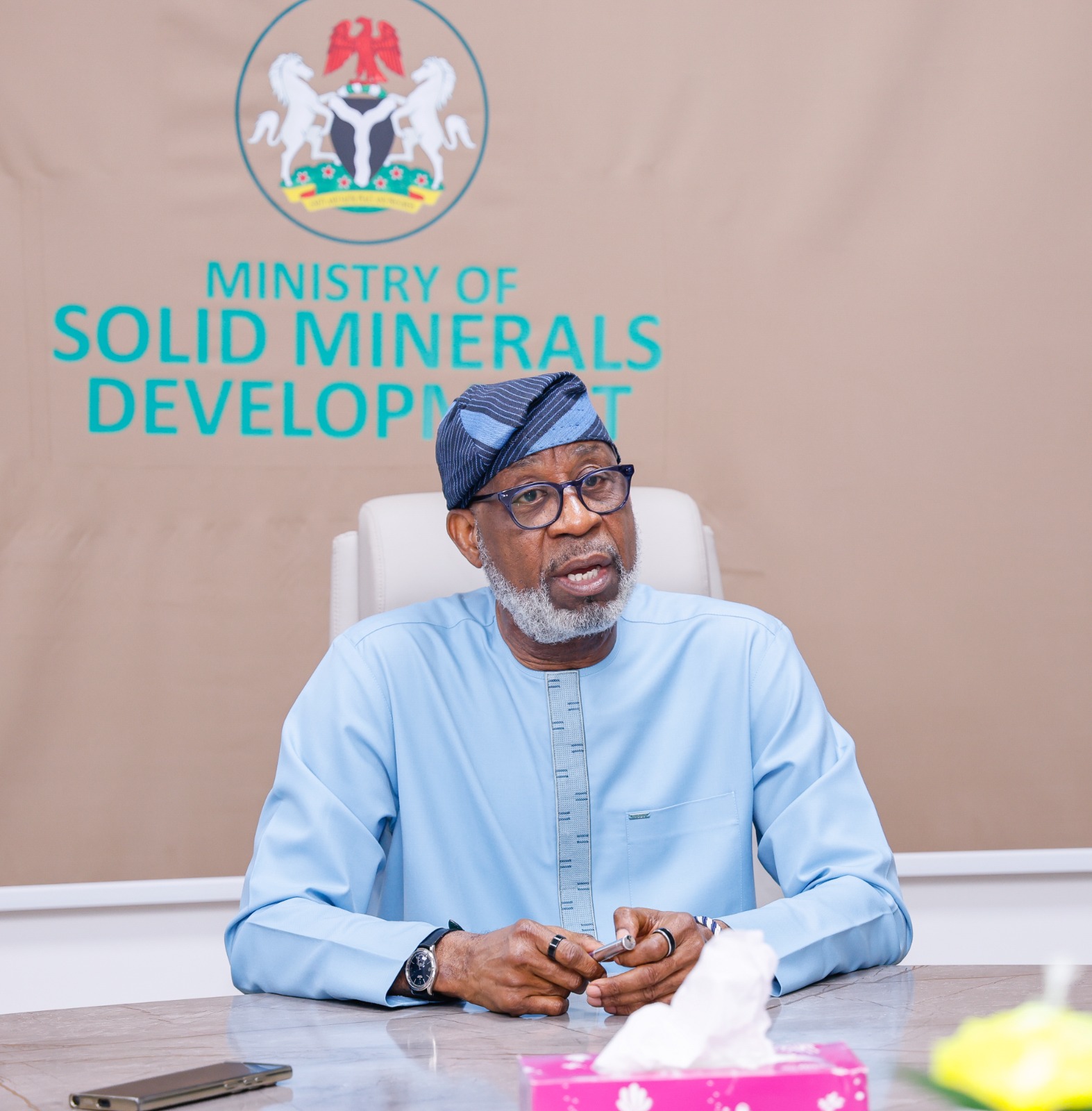
Minister of Solid Minerals Development, Dr. Dele Alake, has said that the roles of the Capital market were critical in unlocking the country’s mineral potentials and closing financing gap in the mining sector.
Alake stated this in his remarks during a Webinar organised by National Association of Securities Dealers Over-The-Counter market in Nigeria, NASD OTC PLC in collaboration with the Solid Minerals Development Fund, SMDF.
He stated that through the webinar, the financing gap in the mining sector was to be addressed—by exploring how Nigeria’s Capital market can serve as a channel for patient, long-term, and strategic investment in the solid minerals value chain.
“It is this financing gap that today’s conversation seeks to address—by exploring how Nigeria’s capital market can serve as a channel for patient, long-term, and strategic investment in the solid minerals value chain,” he said.
Speaking on the theme, “Unlocking Nigeria’s Solid Minerals Potentials Through the Capital Market,” he said this closely alignes with the Ministry’s vision of building a sustainable and investment-driven mining sector—one that serves as a foundation for economic transformation.
He said, “Nigeria is blessed with an extraordinary endowment of solid mineral resources—over 44 commercially viable minerals, ranging from gold and lithium to tin, lead-zinc, barite, and rare earth elements. These resources are spread across the country’s six geopolitical zones, positioning mining as a truly national sector.
“Yet, despite this wealth, the sector currently contributes less than 1% to national GDP. The reasons are well known—insufficient geological data, weak infrastructure, informal operations, illegal mining, and a significant financing gap.”
Represented by Amira Adamu Waziri, the Senior Adviser on Mining and Policy to the Minister of Solid Minerals, he said that the Ministry of Solid Minerals Development, charged with regulating and facilitating the development of Nigeria’s mineral resources has under his administration adopted a clear roadmap to reposition the sector.
He reiterated that Nigeria stands at the threshold of a mining renaissance saying that, “We have the mineral resources. We have the political will. What we now require is the capital, technology, and partnerships to unlock this potential. As we explore the possibilities before us today, let us keep in mind that this sector is not just about extracting minerals—it is about building an economy that is inclusive, resilient, and globally competitive.”
The Minister while commending the NASD OTC PLC and the SMDF for collaborating to grow the sector added, “This webinar marks the beginning of a broader national conversation on using structured capital to unlock mineral wealth. We look forward to collaborating with NSMC, SMDF, and other stakeholders to develop bespoke instruments, listings, and frameworks that will make this vision a reality.
“Let me also underscore that the Ministry remains committed to inclusive and strategic stakeholder engagement. We are open to ideas, partnerships, and joint efforts that advance the collective good of the mining industry.”
Also, Abdulmajeed Oyeyemi Amussah, the representative of the Executive Secretary of the Solid Minerals Development Fund, SMDF, Hajiya Fatima Shinkafi, at the webinar stated that the SMDF was delivering on the Minister’s transformative agenda through joint ventures with mining multinationals especially in its collaborative partnership with African Finance Corporation, AFC.
She also stated the big data on specific seven priority minerals and their deposits, a collaboration which involves investing along with AFC to expand Nigeria’s geoscience capabilities and supporting in the Nigerian Geological Survey Agency, NGSA.
Others the ES said includes: Six mineral processing centres to focus on value added products through investing in the development of a midstream critical minerals processing plant and catalysing private sector investment through the launching of an early-stage exploration financing facility backed by AFC.
Aligning SMDF’s performance with the Ministry’s deliverables to support the delivery of the Presidential priorities, Shinkafi said that the SMDF engaged in joint ventures with mining multinationals which resulted to the collaborative investment partnership with the AFC.
“Train and empower indigenous miners cooperative and mining companies by funding their activities resulting to funding of jewelry and gemstone training programs for 200 indigenous mining entrepreneurs, executing artisanal miner’s formalisation program, supporting the restructuring of BOI ASM- Small Scale lending facility and working on a grants based financing window under the Project Development Facility.
“Increase the Solid Minerals Development Fund to promote the empowerment of indigenous miners which led to the launching of an early-stage project development facility to bridge critical funding gaps,” she said.
On the challenges faced with the application for funding under the AFC-SMDF Project Development Facility, she said that solutions such as capacity building programmes; exploring other funding windows; exploring innovative disbursement frameworks and taking a more active role in project development were measures to be taken to tackle these challenge in the sector.
In conclusion, the SMDF boss reeled out achievements to include: Launching the AFC-SMDF Early-Stage Mining Development Facility to fund and support mining projects; approved funding for initial studies; execution of the first commercial gold purchase transaction resulting in the increase of foreign reserve and the expanded SMDF’s financing sources with improved funding for the formalisation activities as well as delivering the biggest budgetary funding.
In line with the reform drive, NASD Plc Chief Executive Officer, Mr. Eguarekhide Longe, unveiled the National Digital Securities Platform, N-DSP, a blockchain-based infrastructure to support tokenized mining securities.
Longe stated that through tokenized instruments like debt, equity, and mineral-backed securities, channeled investment into exploration, production, and processing, while making capital market participation more accessible and transparent can be made.
He noted that the initiative aligns with the Federal government’s push for value addition, industrialization, and transition from ore exports to in-country beneficiation.
In the same vein, SEC’s Executive Commissioner, Mr. Bola Ajomole, reinforced the urgency, stating that the Capital market must not merely observe the mining renaissance it must fund it.
He revealed that over 867 mining licenses have been issued in 2025, generating N7 billion, with SEC working on mining bonds and royalty-backed securities under a revised Investment Securities Act.