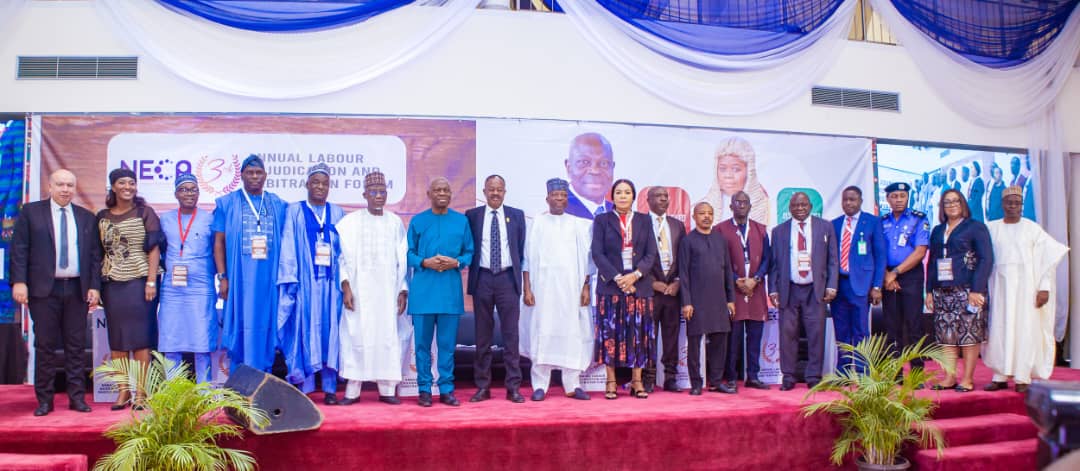
By Michael Oche
The Nigeria Employers’ Consultative Association (NECA) has said the ability of courts and arbitration mechanisms to deliver swift, impartial, and fair decisions is key to maintaining industrial peace.
NECA President and Chairman of Council, Dr Ifeanyi Okoye made the call in Abuja on Thursday while speaking at the 3rd Labour Adjudication and Arbitration Forum organised by the Association.
He said NECA firmly believes that a well-structured and independent adjudication system is essential for economic growth, building trust between employers and employees.
“The adjudication process is the foundation of industrial justice, ensuring that disputes between employers and employees are resolved with fairness and equity,” he said.
Dr Okoye said in the face of the evolving world of work, there is a need to strengthen labour adjudication and ensure that Nigeria’s industrial relations framework remains robust, fair, and responsive.
He added that, “It is our collective duty, as Social Partners, to ensure that these Institutions remain credible, effective, and adaptable to modern labour realities.”
With this year’s theme for the LAAF titled “Labour Adjudication and Appellate Jurisdiction: Challenges and Prospects,” the NECA President acknowledged that as labour relations become increasingly complex, the role of a strong appellate system in upholding justice and maintaining industrial harmony cannot be overstated.
Okoye also called for the resuscitation of the National Labour Advisory Council saying that its role in fostering constructive engagement among social partners is invaluable in promoting industrial harmony and sustainable economic development.
Also, ILO Director-General, Mr Gilbert F Houngbo hailed the annual Forum on Adjudication and Arbitration by NECA, noting that labor conflict prevention and resolution is a key ingredient in creating economic, political, and social stability that is needed for business to succeed.
He urged the government to put creation of decent jobs at the centre of its policy in order to address the economic challenges facing the country.
Reacting to agitation by workers on cost of living, the ILO Director-General commended the government for increasing the minimum wage from N30, 000 to N70, 000 but said there is need to shift the conversation from minimum wage to living wage.
He said, “We do believe in ILO that we have to move away from the concept of minimum wage to a concept of living wage. It is absolutely unacceptable that a citizen would be working 50 hours a week, 60 hours a week, across the world, not only in Nigeria, yet not being able to respond to the basic needs for himself, for herself, for the family, and for the community.”
In his address, NLC president, Comrade Joe Ajaero emphasized the need for fair arbitration for workers, decrying the slow process of some adjudication and its effect on workers.
He said, “If a worker does not have money to hire a lawyer, the matter will not be heard. And in most instances, cases are delayed in those specialised courts for long. If somebody suffers severe injustice from work, and the matter is delayed for 6, 7, 8, 10 years, some of them die in the course of the matter.