By Michael Oche
The Nigerian government, with technical support from the International Labour Organization (ILO), United Nations Development Programme (UNDP), and United Nations Industrial Development Organization (UNIDO), has taken another major step toward strengthening its climate resilience agenda with the validation of its Just Transition Guidelines and Action Plan (JT-GAP).
The plan, developed through extensive consultations with government agencies, labour unions, civil society organisations, and development partners, outlines Nigeria’s pathways for a fair and inclusive shift to a low-carbon economy while ensuring economic inclusion, job security, and social protection for workers and vulnerable communities.
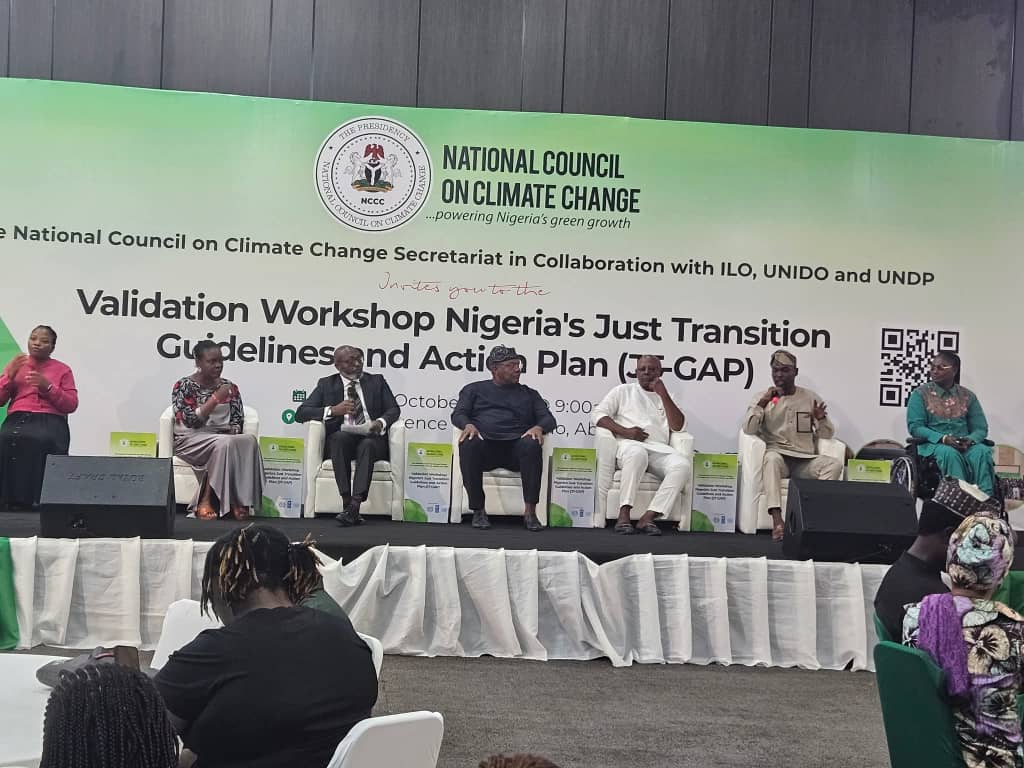
In her welcome remarks at the validation meeting in Abuja on Monday, Teniola Majekodunmi, Director-General of the National Council on Climate Change (NCCC), described the validation ceremony as a “culmination of our foundational work and a decisive, technical step in our journey toward a climate-resilient, low-carbon, and inclusive economy.”
Represented by Mr. Chukwuemeka Okebugwu, the director general said the Just Transition concept, which began as a labour movement idea, has now evolved into a central pillar of global climate policy, embedded in the Paris Agreement and operationalized under the UNFCCC Just Transition Work Programme.
Majekodunmi noted that Nigeria’s framework remains uniquely African-led and context-specific, anchored on the principles of equity and Common But Differentiated Responsibilities and Respective Capabilities (CBDR-RC).
“This commitment guarantees that our transition is just, fair, and inclusive, ensuring no Nigerian is pushed to the margins of economic activity due to climate-induced job losses or reduced resilience,” she said.
She explained that the JT-GAP serves as a strategic instrument to integrate social and economic dimensions into Nigeria’s broader energy and climate transition plans.
Explaining further, Majekodunmi said the plan provides the workforce component of the Energy Transition Plan (ETP), mitigates job displacement risks, and promotes new green jobs, skills development, and social protection measures.
The director general added that the plan also supports the implementation of the National Climate Change Act (2021) and the country’s Nationally Determined Contributions (NDC 3.0), aligning all actions with the government’s agenda for inclusive growth.
In her goodwill message, Venessa Phala, Director of the ILO Country Office for Nigeria, Ghana, Liberia, Sierra Leone, and ECOWAS, noted that the validation of the JT-GAP is important for Nigeria, as the document is meant to guide the transition to a low-carbon economy in various sectors, ensuring inclusivity, equity, and shared prosperity.
Represented by Guite Diop, the director said Nigeria has shown commitment towards a climate-resilient economy, especially following the recent submission of its Nationally Determined Contributions (NDC 3.0) and the development of its Just Transition Guidelines and Action Plan.
She said, “For us in ILO, just transition defines an approach to environmentally sustainable economies that creates decent work and maximizes social and economic opportunities while minimizing challenges. It requires that workers, enterprises, and communities are included in decision-making through social dialogue and that the transition respects fundamental principles and rights at work.”
Phala noted that to enhance inclusivity for climate-related policies in Nigeria, such as the Just Transition Guidelines and Action Plan, stakeholders must explicitly incorporate measures to protect vulnerable groups, especially women and people with disabilities, migrants, and mobile workers; strengthen access to and portability of social protection benefits; and ensure skills training for public works for climate adaptation, including upskilling and reskilling of workers. Comrade Echezona Asuzu, the Nigeria Labour Congress (NLC) focal person for climate change, in his goodwill message, commended Nigerian workers for putting up a good fight to ensure that workers’ voices resonated in the JT-GAP.
He also commended the ILO and UNIDO for their support in developing the JT-GAP, while also calling for more of such support going forward, especially the crucial stage of implementation of the plan.