Agency report
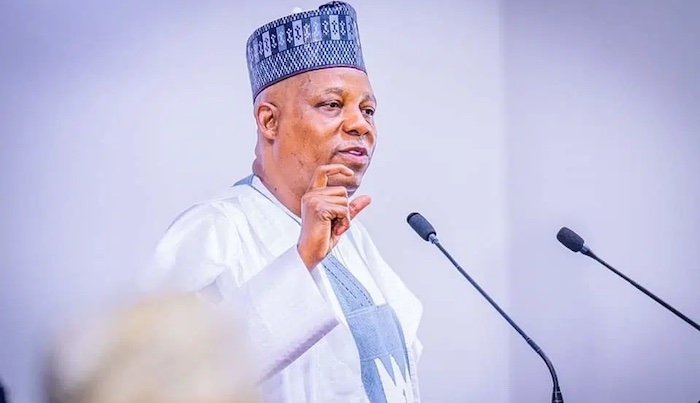
Vice-President Kashim Shettima says Nigeria’s energy transition journey under President Bola Tinubu’s administration is unlocking an investment opportunity of over $410 billion between now and 2060.
Mr Shettima said this on Tuesday in Abuja at the inaugural Nigerian Renewable Energy Innovation Forum (NREIF) 2025.
According to the vice president, the investment will position Nigeria as the heartbeat of Africa’s renewable energy revolution.
Mr Shettima said that over $23 billion is needed to expand energy access and connect the millions of Nigerians who still live in energy poverty.
The vice president noted that as the world sails fast towards net zero, Nigeria and Africa must not be left behind.
“We have too much at stake. We are blessed with the minerals that power clean technologies, and Nigeria brings to the table youth, ambition, and untapped renewable potential.
“Let us seize this moment. Let us affirm that Nigeria is ready, ready to harness her resources, unlock her capital, and become the vibrant heartbeat of Africa’s renewable energy revolution.
“Nigeria’s energy transition is targeting an investment opportunity of over $410 billion between now and 2060, with over $23 billion needed to expand energy access and connect the millions of Nigerians who still live in energy poverty,” he said.
According to him, beyond access lies our grander ambition, which is to deliver a power system capable of 277 gigawatts of total installed capacity by 2060.
“This ambition demands more than investment; it demands innovation, local capacity, and commitment,” he added.
He assured investors, development partners and other stakeholders at the forum of Mr Tinubu’s commitment to consolidating policy foundations that would lead to a renewable energy market that is self-sustaining.
“We are enhancing incentives for local manufacturing, streamlining regulatory frameworks, and deepening collaboration with state governments, investors, and development partners.
“This is with a view to de-risking private capital and accelerating the emergence of a self-sustaining renewable energy market. Nigeria’s first industrial strategy demands that the future of Africa’s renewable energy supply chains be anchored indigenously.
“From solar panel assembly lines in Lagos to battery recycling hubs along our industrial corridors, Nigeria must not only participate in this revolution but lead it,” Mr Shettima said.
Mr Shettima hinted at the federal ministry of power’s readiness to develop policies that would lay the foundation for a more decentralised, competitive, and inclusive electricity market.
The vice president, however, noted that efforts to prioritise energy transition cannot succeed without the private sector.
He called on development partners and original equipment manufacturers to localise technologies, strengthen value chains, and invest in skills and knowledge transfer.
“We count on our state governments to champion renewable industrial clusters and serve as engines of green growth across the federation.”
Mr Shettima urged participants at the forum to reach agreements, forge partnerships and consolidate a national roadmap that would unfold the over $400 million investment in Nigeria’s renewable energy manufacturing value chain into a reality.
The minister of power, Adebayo Adelabu, said the forum marks a new chapter in Nigeria’s energy transformation pathway that highlights the role of innovative partnership in targeting significant amounts of local solar energy production capacity.
Mr Adelabu said the government’s multipronged approach is aimed at addressing Nigeria’s structural challenges and unlocking private capital in a bid to transform the entire energy sector value chain. NAN