…Minister applauds Presidential tax waiver on sanitary towels, partners pledge robust implementation nationwide
By Palma Ileye
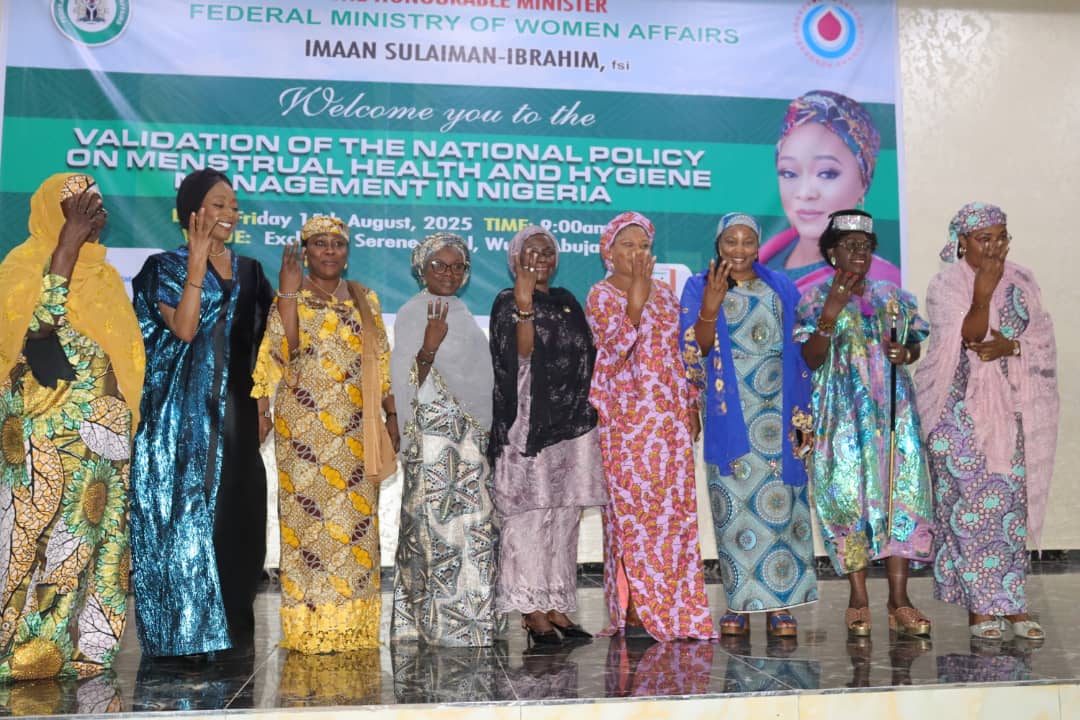
Ministry of Women Affairs, in collaboration with development partners, have validated the first-ever National Policy on Menstrual Health and Hygiene Management, MHHM, marking a landmark moment in Nigeria’s commitment to the dignity, health, and empowerment of women and girls.
The high-level meeting, held in Abuja, brought together Commissioners from across the Federation, development partners, civil society organisations, and other key stakeholders.
The Minister of Women Affairs, Hajiya Imaan Sulaiman-Ibrahim who was represented by the Permanent Secretary, Dr. Maryam Ismaila Keshinro, delivered a compelling keynote address underscoring the urgency of tackling menstrual health as a national development priority.
The Minister in a press release signed by EmemMARIA Offiong, Assistant Director, Head Press Info and Public Relations, of the Ministry of Women Affairs commended President Bola Ahmed Tinubu, for his visionary leadership, particularly his recent approval of tax waivers on sanitary towels under the newly signed Tax Reform Act.
She described the move as a “landmark intervention” that will remove economic barriers and make menstrual products more affordable for millions of women and girls, including those in rural areas and internally displaced persons’ camps.
“By 2030, no girl in Nigeria should have to choose between managing her menstruation and pursuing her education,” the Minister declared, stressing that menstrual health is not a privilege but a right.
The Permanent Secretary, Dr. Maryam Ismaila Keshinro, welcomed participants and emphasised that synergy between federal and state governments is crucial for the successful implementation of the policy.
She lauded the inclusive consultation process that shaped the document, calling for unity of purpose in transforming policy into tangible benefits for women and girls nationwide.
Development partners reaffirmed their commitment to making the policy a reality. Evelyn Mere, Country Director, WaterAid Nigeria, noted that only 11% of Nigerian schools currently have basic WASH facilities, with many lacking privacy, clean water, or gender-sensitive infrastructure.
She stressed that the policy’s comprehensive approach—covering menstrual products, sanitation infrastructure, education, and stigma reduction—would be “transformative” for the wellbeing and opportunities of Nigerian women and girls.
“This policy emerged from genuine consultation across all six geopolitical zones, ensuring it reflects the unique challenges faced by women and girls nationwide,” Mere stated. “We are committed to turning this bold vision into lasting change by supporting robust implementation.”
Similarly, Mrs. Fifi Ogbondeminu, Acting Country Representative, Population Services International, PSI, Nigeria, highlighted the organisation’s Menstrual Health No Wahala, MH-NoW, programme and pledged readiness to collaborate with all levels of government to ensure availability of affordable menstrual products, integrate menstrual health into education systems, and create enabling environments that eliminate stigma.
The meeting concluded with a unified call for action from all stakeholders—government agencies, civil society, and development partners—recognising that while policy validation is a major milestone, the real impact will be measured by its successful implementation across Nigeria, from urban centres to the most remote communities.
About the National Policy on MHHM
The National Policy on Menstrual Health and Hygiene Management (2025–2030) provides a strategic framework to ensure that every woman and girl in Nigeria can manage menstruation safely, hygienically, and with dignity.
It addresses access to menstrual products, water, sanitation, hygiene, WASH, infrastructure, education, and the elimination of stigma and discrimination related to menstruation.