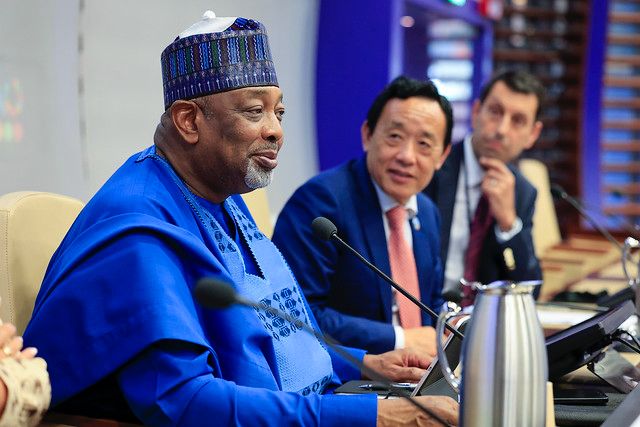
Government officials and experts discuss innovative policies to enhance agricultural productivity and food systems for sustainable growth.
By Palma Ileye
Minister of Agriculture and Food Security, FMAFS, Sen. Abubakar Kyari has said that proactive policies in the agricultural sector would unlock sustainable food systems to safeguard the climate, restore soil and ecosystems, boost production as well as secure dignified livelihoods for Nigerian farmers.
Kyari made this known at the High-Level Event: “Unlocking Sustainable Agrifood Systems for Climate, Nature, and Livelihoods” during the Standing Committee on Finance, SCF, Forum of the United Nations Framework Convention on Climate Change, UNFCCC, held in Rome, Italy.
He recalled that in 2022, the Federal Ministry of Agriculture and Food Security, previously known as the Federal Ministry of Agriculture and Rural Development, established a partnership with Food and Agriculture Organization of the United Nations, FAO, through the Monitoring and Analyzing Food and Agricultural Policies, MAFAP, Programme.
This collaboration he said, has enabled FAO to conduct extensive policy analyses, which have significantly informed Nigeria’s agricultural policymaking.
In a press release signed by Ezeaja Ikemefuna, Head, Department of Information of the Ministry, he said that Nigeria was spearheading a national initiative to create a climate-resilient, nature-positive food system, in line with various national policies adding that current strategies include distributing improved seeds, promoting sustainable soil management, increasing food production, and expanding agroforestry.
He stated that the National Agrifood Systems Investment Plan, NASIP, aims to enhance agricultural investments, boost agrifood production, create jobs, alleviate poverty, and make healthy diets more affordable. At the same time, it seeks to lower greenhouse gas emissions from agrifood production and promote reforestation.
The Minster revealed that Nigeria’s forthcoming Nationally Determined Contributions, NDC 3.0, aims to align climate commitments with inclusive agricultural transformation saying that key priorities include: Scaling climate-smart agriculture for crops and horticulture, Restoring degraded lands through sustainable practices, Promoting regenerative agriculture and agroecology, and Empowering smallholder farmers, particularly women and youth, with essential resources.
Kyari added that building on these priorities, Nigeria has advanced its National Adaptation Plan, NAP, which integrates adaptation priorities into agriculture, water, health, and infrastructure, with a strong focus on community-led solutions and ecosystem-based approaches.
He pointed out that Nigeria was positioning itself under Article 6 of the Paris Agreement, creating enabling policies and market mechanisms for carbon trading and results-based finance and by leveraging carbon credits from climate-smart agriculture, afforestation, and ecosystem restoration, Nigeria aims to attract additional investment while supporting smallholder farmers.
He mentioned the development partnership projects enhancing the sector’s resilience includes; The Special Agro-Industrial Processing Zone, SAPZ, programme, The Value Chain Development Programme, VCDP, The Livelihood Improvement Family Enterprise in the Niger Delta, LIFE-ND, The Rural Access and Agricultural Marketing Project, RAAMP, and The National Agricultural Growth Scheme – Agro Pockets, NAGS-AP.
He acknowledged that additional funding was crucial to develop climate-resilient crops and implement sustainable agricultural practices, addressing the significant challenges posed by climate change and ensuring food security for all nations.
The Minster called all stakeholders saying, “To action to fulfil our strategic mandates. Let all nations commit to coherent national strategies that align climate objectives with agricultural development, backed by catalytic finance and policy reform. Let international financial institutions: IFAD, FAO, GEF, and others scale up concessional and blended finances, share risk, and support scalable, high-impact programmes that reach smallholder farmers and rural communities.”
He appreciated the technical support from FAO and IFAD through the Global Environment Facility’s Food Systems Integrated Programme, FSIP noting that, “This global programme is not only supporting us in Nigeria but also connecting countries to share knowledge, experiences, and innovations. Such collaboration is vital as we work collectively to transform food systems for sustainability, resilience, and inclusiveness.”