
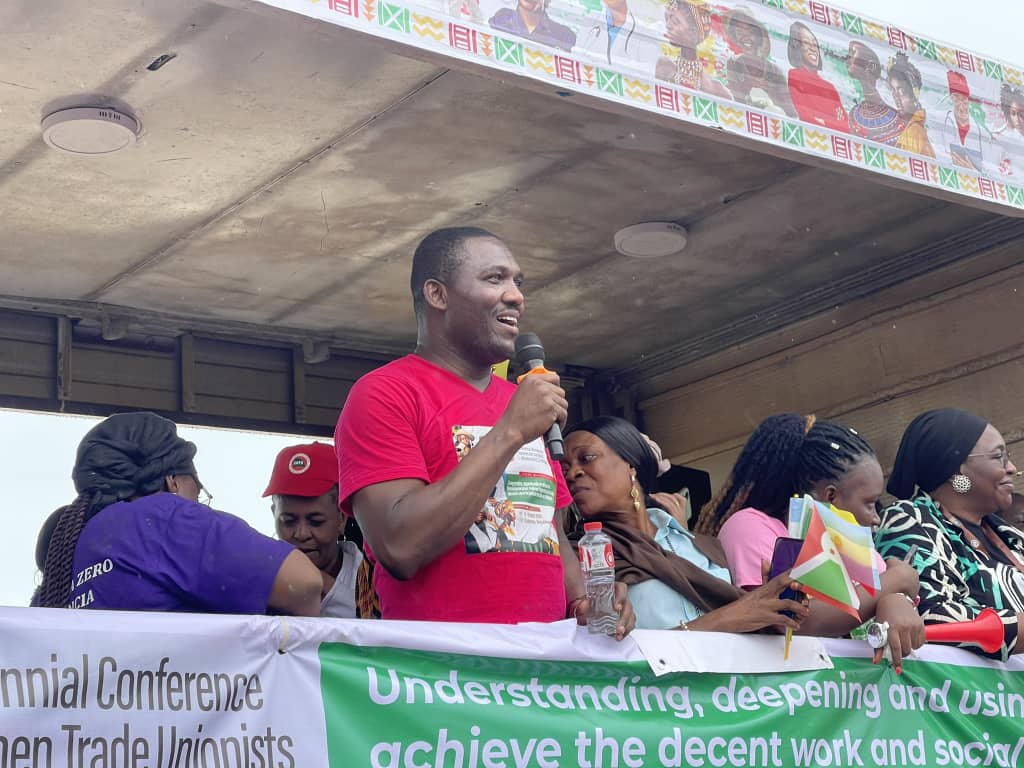
Comrade Akhator Joel Odigie is the General Secretary of the African Regional Organisation of the International Trade Union Confederation (ITUC-Africa). The ITUC-AFRICA is a Pan-African trade union organization representing over 18 million workers in 52 of the 54 African countries, including Nigeria, where the Nigeria Labour Congress (NLC) and Trade Union Congress (TUC) are its Nigerian affiliates. In this interview, comrade Odigie shares his experience leading the organization in the last year since emerging as its General Secretary (GS) during the organization’s 5th Delegates Congress, which took place in late November 2023 in Nairobi, Kenya. He captures how trade unions have been proffering solutions to some challenges ravaging Africa while also projecting plans for 2025.
You took over as GS at a time of shrinking civil space in Africa when trade union leaders have been harassed and even arrested; how has ITUC-Africa provided leadership for workers to open these spaces?
When we took over the leadership of ITUC-Africa, it was the era of post-COVID. You know, with COVID-19, there was the lockdown and everything. When we opened up after the lockdown, the experience was that the spaces trade unions operate within in the advancement of civil liberties have shrunk considerably. Several countries that had locked down had imbibed or enjoyed the unilateral posture of locking down the rights of people, especially the right to assemble, express dissent, expression, and protest. We had to struggle to make the point that these rights are critical for ensuring accountability and preventing impunity.
The time we took the mantle of leadership was the height when jobs, savings, and industries have been lost to the pandemic. It was the time to rebuild and contribute to the restoration of confidence in our people and economies. It was becoming difficult to return to normal. And then, of course, the era where digitalization intensification was on the ascendancy, deepening flexi-working and platform employment in the gig economy. To try to come back from all of these, we needed to do many things differently.
Of course, when you juxtapose the Ukraine and Russia war and other continental and global tensions, one can assert that the world remained very challenged socio-economically and politically.
Several governments have been acting with the approach of remaining in a “COVID-19 mood” to limit the enjoyment of civil liberties. On the continent of Africa specifically, when you add the insecurity situation of countries, notably the Sahel, and the resultant actions of undemocratic or military takeover, you’ll find that the whole atmosphere was that civil liberties began to come under focus and attack.
How did ITUC-Africa step in to ensure that these issues were addressed?
Our duty, our mandate, is to defend civil liberties, and we do so with, first, the understanding that plural and participatory democracy offers an opportunity to advance rights, and so we defend democracy. We want to consolidate democracy; notwithstanding, we also have to take into account the realities of some countries that have gone under military rule and understand their context without having a blanket negative and dismissive interpretation. Of course, we equally frown at and reject the manipulation of institutions of democracy, elections, and governance.
So, our work, as ITUC-Africa, has been to mobilize our members to defend rights through several actions. Critical to that is helping them to build stronger unions. Critical to that is advancing our argument that trade unions’ struggles are not just about bread and butter issues. Rather, trade unions are also interested in and concerned with issues of development in their countries, in their communities, within their family units, and the betterment of the individual. We are conscious in terms of how we frame our issues to be broader than just traditional formal wage earners’ issues – to be issues of our communities, issues of our economies, and issues of our people, and how to get results for them through collective actions. Our approach is not that of lamentation, neither is it of just the business of criticism. We engage in critical analysis of the issues and then provide alternatives, including the processes that would contribute to the improvement of the situation. For example, regarding the issues of insecurity and poverty, we continue to urge our governments, aside from the military option (in the former case), to embrace dialogue and accelerate the provision of social security provisions and safety nets initiatives. We need social protection provisions for all workers, including those in the informal economy. We also need to expand decent employment creation possibilities. We have moved further to identify that it goes beyond mere advocacy for social protection or the expansion of social safety nets and job creation. Rather, we need to expand the financing possibilities for social protection and job creation. We have seen that it is difficult for African countries to generate the needed resources to finance social protection, partly on account of the heavy burden of debt servicing and high Illicit Financial Flows (IFFs) activities of big businesses, especially in the extractive, finance, manufacturing, and services industries.
What other strategies did the ITUC-Africa deploy?
Also, beyond that, in terms of strategy to protect civil liberty spaces, is that we have deepened our resolve to provide capacity for our people to be able to take action and intervene. More importantly, we want to build a bigger and stronger organization. If we organize, our voices will remain critical. If we are not serious and focused on organizing the civil liberties spaces, encroachment will continue. So we want to reverse that through building strong unions, and that means organizing workers across sectors and categories of workers – informal economy workers, women, youth, physically challenged workers, migrants workers, and platform workers without exception and discrimination.
And then, of course, we must be reporting. We are bringing to national, continent, al and international attention the shrinking spaces and how they are happening. We are bringing that to the o public through monitoring and reporting on them. Reporting through different mechanisms like the African Commission on Human and Peoples Rights, like through the annual report that we developed as the ITUC Global Rights Survey, by reporting to the Committee of Experts on the Application of Conventions and Recommendations (CEACR). These are different means of reporting, including the United Nations Human Rights Commission.
Can you highlight specific milestones achieved in key campaigns or programs initiated under your leadership?
Some milestones we have achieved in our campaigns and programs. First, I’m happy that we have given increased attention to women’s issues, women in trade unions, and women in our communities and societies. We want to take it further. We have committed to the empowerment of women through training, reversing gender-based violence, and access to participation and leadership opportunities. So, today, when we look at the statistics on access to training opportunities, we modestly boast that we are oscillating around 50 percent of women’s participation.
Another milestone is that our campaign to defeat the debt overhang is gradually paying off through renewed and increased attention to the issue and some positive responses from the creditors. This is the case for Zambia where our advocacy and street campaigns partly led to debt rescheduling for the country.
Another milestone is that we have pragmatically redefined our trade union education to be action-focused. For the educational activity we organize, we put side-by-side action to it. For instance, in March 2024, we organized our New Year school in Lusaka. We were on the streets in Lusaka, Zambia, campaigning for debt rescheduling arrangements for Zambia. Four days after that rally, we got good news that Zambia has been granted a debt rescheduling arrangement. It was not just that we were rallying on the street; we wrote letters to the different creditors on what to do. I think that is one good milestone because Zambia got the respite they needed.
Another milestone for us is on the tax front. Our contribution to shaping a UN Global tax architecture is taking shape, and at the international level, this is recognized, and Africa has been very active on this front. And we can say, as ITUC-Africa, we were part of the African voice that led to this success. I would say it’s not a done deal, but the fact that there is an agreement on that and the initiative is ongoing is, for us, a milestone.
We are happy to report within the year that we have also remained very focused on our work on research. If you look at it, in the last few periods, we have been churning out actionable research that we are using to support their campaigns on the ground. These are good milestones that we are happy about. We are also happy that we are building the convergence of trade unions on the African continent at the National and sectoral level for more and better organizing of workers. This is something we also celebrate.
Are there any lessons from your first year that will shape your strategies moving forward?
One of the lessons for me is that, indeed, the work is huge. Also, it is important to stay focused on building alliances and solidarity. Another lesson is that we shouldn’t be impatient. We should just remain focused because it’s a huge work. It’s a marathon, and we should always look for opportunities for quick wins, simple wins, and good wins that we can celebrate to inspire and motivate us to continue the struggle. Otherwise, there is a tendency to be discouraged that you are doing a lot and you’re not seeing the result. It’s a marathon because the issues are huge.
How do you envision ITUC-Africa’s role in addressing Africa’s pressing labor challenges, such as unemployment, wage disparities, and workers’ rights violations?
On the questions of unemployment, wage disparities, and workers ‘ violations and how we envisage an ITUC Africa response, we envisage, we envision, a stronger African trade union movement that can advocate these issues. So we want to build stronger unions. 2025, for us, is the year of organizing for social justice. That’s how we have captured it for Africa, the year of organizing for social justice. So, if we want to improve the well-being and welfare of our people, we need a strong and virile organization positioned to push for employment creation, negotiate and ensure fair application and enforcement of collective bargaining agreements and minimum wage outcomes. If we don’t have such an organization ready, we cannot achieve these.
On the question of 2025, we envision where we will also be driving campaigns on collective bargaining. How do we get more development of minimum wage on the continent and take wages out of competition? People should not necessarily compete on account of wages.
And then, of course, ascribe and push for a living wage. Doing this means we are concerned about productivity on the continent, and we want to put more effort into driving that. Linked to that is the question of employability and employment. We want to continue to strengthen our advocacy for skills development and standardisation of qualifications. We shall also continue to advocate for retraining for workers, given the intensification of digitalization. People should be able to learn new skills and take up new roles in their different economies. More importantly, the provision of social protection for people so that they can learn, work, and live in good condition that promotes wellness and well-being.
What specific initiatives has ITUC-Africa launched to tackle climate change and its implications for workers?
On the climate change front, the initiative we have revived is the initiative of energy justice. If we have energy, we can contribute to just transition as a way of addressing the climate change issue. The other initiative we have launched is to encourage our people, though not new, but something we need to stay consistent with and on, is to plant trees and to take delight in transitioning away from harmful environmental practices and embracing friendly ones. And then, of course, to also be loud on the climate change financing discourse for Africa to address adaptation and mitigation issues. So those are some of our push in that direction. Then, at the National and continental levels, we are encouraging our members to be very active in the Nationally Determined Contribution (NDC) processes for climate change financing and remain seized at the continental and international levels for fair and equitable financing for a just transition.


