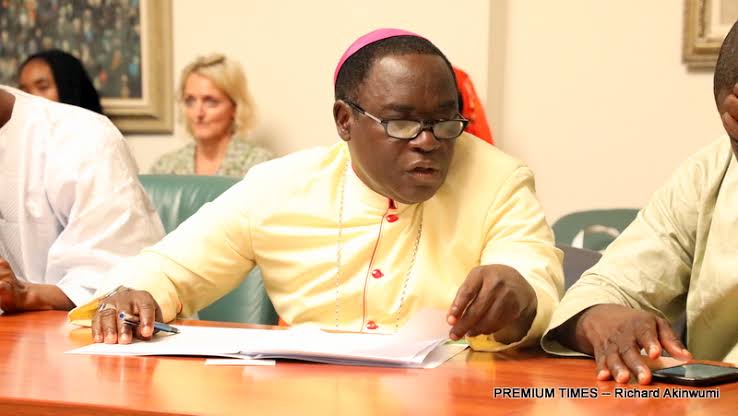
Religious leaders Sultan and Kukah emphasize the importance of family values to address Nigeria's insecurity issues during a meeting.
By Ebute Mathew, Kaduna
The Sultan of Sokoto, Alhaji Muhammad Sa’ad Abubakar III, and the Bishop of Sokoto Catholic Diocese, Archbishop Matthew Kukah, have underscored the urgent need to restore strong family values as a foundation for national security and social stability in Nigeria.
The two eminent religious leaders delivered their messages on Monday at the opening of Exercise Haske Biyu 2025, held at the Armed Forces Command and Staff College (AFCSC), Jaji, Kaduna State.
Delivering a paper titled “Relationship Between Family Dynamics and National Security” on behalf of Archbishop Kukah, Rev. John Joseph Hayab, Chairman of the Christian Association of Nigeria (CAN) in the 19 Northern states and the FCT, emphasized that a majority of Nigeria’s social crises can be traced back to broken or dysfunctional family systems.
“Many parents, due to several factors, are unable to raise their children to be responsible citizens,” Kukah noted, linking youth radicalization and social unrest to inadequate family upbringing, lack of education, and a growing obsession with materialism.
Citing Proverbs 22:6, Hayab reinforced that early moral guidance within families is critical for raising disciplined, law-abiding citizens.
He explained that families are where children first learn empathy, emotional intelligence, and conflict resolution, all of which are essential for a peaceful society. Families that model healthy behaviour, he added, contribute to building communities that value tolerance, unity, and nonviolence.
Archbishop Kukah further recommended policy actions, including government investment in family support programmes, counselling services, and grassroots initiatives aimed at strengthening homes and communities.
Also speaking, the Sultan of Sokoto described the family as “the smallest yet most important building block of society,” warning that societal decay begins when families fail in their responsibilities.
“Weak families produce weak communities, while strong families sustain peaceful and resilient nations,” the Sultan said.
He referenced the historical Sokoto Caliphate, noting that family values were central to its governance and social policy, particularly through the teachings of Sheikh Abdullahi.
The Sultan expressed concern over modern threats to family stability — including corruption, unchecked access to harmful online content, and poor parental involvement, all of which, he said, expose children to moral decay and digital dangers.
To reverse the trend, he called for: Strengthened marriage advisory councils, Integration of value-based education into school curricula, tighter drug control policies, and Government commitment to tackling the issue of out-of-school children.
He stressed, “The world has not and will never invent anything to replace the family.”
Both leaders urged the Nigerian government and stakeholders to recognize the family as the cornerstone of any sustainable security strategy.
They emphasized that the long-term solution to Nigeria’s insecurity lies not only in military might but in restoring the moral and social fabric of the nation — beginning in the home.
“We think that the President and his team have worked hard to stabilise the economy. You cannot really improve an economy unless it is stable. So, he has to be given the credit for the stability of the economy. The reforms have been in the right direction, she said in a chat with newsmen after she met with the President Bola Tinubu, the WTO boss said,
“What is needed next is growth; we now need to grow the economy and we need to put in social safety nets so that people who are feeling the pinch of the reforms can also have some support to weather the hardship. That’s the next step,” the former minister added.